Jumat, 28 Desember 2007

Down and Out

A few more minutes before the market close, and last day for trading for this year. Our account is in a drawdown when carrys unwind today, dragging the bleeding US dollar after the previous recovery. Not a nice way to end the year. Well... thats part of trading.


Big thanks to everyone who has read this blog and supported our advertisers this year. wishing you all a

merry cristmas and a happy new year!

hope to see you all back here after the holidays.

Investment Banks Expand into Retail Forex

Forex is becoming hot! Average daily volume has surged past $3.2 Trillion, as the credit crunch has increased volatility and the Dollar has collapsed. In fact, Saxo Bank, one of the most prominent acts in retail forex trading, may record $500 million in revenue this year. As a result, several of the world's largest investment banks have announced plans to enter the burgeoning retail forex market. Citigroup is teaming up with a Danish bank to offer online currency trading. Deutsche Bank is stepping up marketing of its proprietary retail trading platform. Even Goldman Sachs is entering the fray, via a 10% investment stake in a British retail forex company.

Read More: Global banks compete for growing forex business

Selasa, 25 Desember 2007

Thin Holiday Trading


Merry Christmas and a prosperous 2008 to all my readers.

Yesterday Foreign Exchange trading volume shrank to around a quarter of normal levels due to holiday in Japan and Christmas Eve in US, Canada, and European countries. The yen fell against high-yielding currencies as rising Asian and European stocks encouraged investors back into carry trades. The dollar reached as high as 114.46 versus the yen, and the euro climbed around 100 pips to 164.87.

The euro climbed to a fresh all-time high at 0.7288 versus the sterling on concern that UK economy is slowing down and the Bank of England may continue to cut interest rates next year. In contrast, the European Central Bank is likely to keep rates unchanged in 2008.

Jumat, 21 Desember 2007

EUR/CHF Up or Down?


Will EURCHF trend up or down next week? Fundamental views is up while the daily chart shows mixed signal.

Carry Trade Gains Favor

It's been rough sailing for the Yen carry trade of late; the technique had been sagging in popularity due to the credit crunch and the associated trend towards risk aversion.

Over the last few weeks, however, the Yen has fallen, which is to say the Yen Carry Trade is making a comeback. First, came the announcement that the world's leading Central Banks would be injecting hundreds of billions of dollars in the banking system, in order to ease growing liquidity concerns. Next, the Bank of Japan hinted that it would hold rates at .5%, the lowest in the industrialized world. Finally, a continued surge in commodity prices virtually ensures that countries rich in natural resources, such as Canada and Australia, remain viable "targets" for carry traders.

Overall, the story remains focused around volatility. In fact, one investment bank discovered an inverse correlation between the S&P 500 and the Japanese Yen. In other words, the appetite for risk appears closely correlated with the strength of global capital markets and the popularity of the Yen carry trade.

GBP/JPY surge the whole day yesterday, while EUR/CHF trended up and made a slight corretion after hitting the upper channel that I mentioned yesterday.

Kamis, 20 Desember 2007

EUR/CHF 12.21 Analysis


Zooming in to the 1h chart, EURCHF caught in a range within a channel. Break of the lower channel will test the previous strong support at 1.6550, thats the 61.8 fib of the 12/05/07 low to 12/14/07 hi swing. Breaking the upper channel will test the major trendline I mentioned on my earlier post.

Right now, 1h and 4h are in bear bias with 72EMA so flat showing to clear direction. Daily chart showing a possible bull forming, but Stoch and CCI curved up at the middle of OB & OS, which makes me hesitate to conclude a bull. 1h to daily ADX shows no (low) momentum since monday. I will still stay aside while holding some drawdown positions.

This next analysis has nothing to do with true north hedge trade. Just pointing out how to use the template I sent out to our members.


NZDUSD dailies is also within a uptrend channel. Stoch & CCI about to crossed up. Price having a hard time breaking the lower channel. If broke, target would be the 50% fib (.7290). Enter at 0.7420 confirmation, set SL at the lower channel.

However, if price bounced from the lower channel. Set entry at 0.7640 with TP at the upper channel, SL at 0.7420. This is a long term trade which moght take days to reach the target. Trade it at your own risk. Not recommended to included this trade with your hedge trade account.

Rabu, 19 Desember 2007

ECB Pumps Record Liquidity into Market

The ECB announced that it would offer unlimited funds at below market interest rates in an effort to preempt a credit crunch heading into the end of the year. The bank confirmed it had allotted 348.6 billion euros at 4.21% to pump into the financial system, if deemed necessary. The move is another sign that last week’s coordinated intervention was deemed insufficient by the ECB to free up credit markets and deter a liquidity crisis.

The euro edged back above the 1.44-level against the dollar in a directionless session as liquidity winds down heading into the end of the year. The single currency is likely to remain under pressure as the dollar remains buoyed amid widespread position squaring and overall reassessment of the extent to which the FOMC will be able to ease rates over the coming months – given stubborn inflationary pressure in the US.

Trading conditions will likely remain thin heading into the year-end holidays, with a bias towards a higher dollar as traders close their books. Nonetheless, volatility could also pick up given the thinning liquidity.

Senin, 17 Desember 2007

Central Banks Inject Liquidity

After months of delay and perhaps overly wishful thinking regarding the global credit crunch, the world's Central Banks are finally ready to take action.

America's Federal Reserve Bank will join forces with the Bank of Canada, the Bank of England, the European Central Bank and the Swiss National Bank as part of a concerted effort to introduce greater liquidity into global capital markets.

Under the plan, the Banks will auction off tens of billions of Dollars worth of bonds denominated in their respective currencies, and lend the proceeds to commercial banks. The goal of the plan is to to limit growing risk aversion, which has caused banks to significantly rein in lending.

Further, while the move is designed primarily to boost confidence in equity markets, certain sectors of forex may also receive a bump. High-yielding currencies such as the New Zealand Kiwi and Australian Dollar, which have been shunned in recent months, seem to be the most likely beneficiaries.

Read more at Forbes.com

This is good news for collerated pairs hedge traders and carrys tarders or the whole global economy. But until then, carry pairs are still in bearish bias until rumour is digested.

EUR/CHF 12.18 Analysis


EURCHF daily chart- It broke the (minor) support trendline yesterday with great volume suggesting a bearish trend formed.

Price now at 1.6550, 50% fib of Oct. 29 high to Nov. 23 low. Confluence with the 72EMA (purple line). I think price will bounce a bit from here before go down further.

Game Plan: If it make a upward correction today, and your positions reached breakeven, close it. Stay away from the market 'til the upper trendline (orange line) on the daily chart is broke. Lower trendline is a good level to start a long hedge, if you still have enough margin left to risk. But before that, watch out on 1.6500 to 1.6450 level, another minor support level before the lower trendline.

Minggu, 16 Desember 2007

EUR/CHF 12.17 Analysis

Photo Sharing and Video Hosting at Photobucket

EURCHF 4h chart- Watch the 2 support trendline. Price seems to bounced on the first one with Stoch and CCI supporting the view.


Photo Sharing and Video Hosting at Photobucket

EURCHF 1h chart- Same scenario as 4h chart, Stoch and CCI about to crossed up. Wait of a confirmation. Broke of the support trendline means bearish trend is formed.

However, we have a bearish bias on the daily chart.I will stay out on this one. I'm expecting these 2 weeks to have low volatile market due to holiday season.

Selasa, 11 Desember 2007

Fed Expected to Cut Interest Rates Again


Faced with a spreading mortgage crisis, the Federal Reserve is expected to cut interest rates for a third time later and hint that even more rate cuts could be forthcoming.

Fed Chairman Ben Bernanke has clearly signaled this outcome in a speech last month in which he said that the latest bout of financial market turbulence raised greater risks for the economy.

Most economists are expecting a quarter-point cut in the federal funds rate at Tuesday's meeting, which will be the Fed's last rate-setting discussion this year. That would push the federal funds rate down 4.25 percent and send bank's prime lending rate, the benchmark for millions of consumer and business loans, down to 7.25 percent, the lowest level in two years.

The Fed started cutting rates in September with a bolder-than-expected half-point move and then reduced the funds rate by a quarter-point at its Oct. 31 meeting. The central bank was trying to make sure that a severe slump in housing, spreading mortgage defaults and financial market turbulence which hit with force in August did not derail the economy.

In its October announcement, the Fed indicated that its two rate cuts might well be all that would be needed to make sure the country was not pushed into a recession.

But that view has undergone a dramatic about-face in the six weeks since that time, reflecting worsening conditions in financial markets and continued sharp declines in housing as lenders tighten standards in response to rising mortgage defaults.

Many analysts believe the current quarter and the early part of next year will represent the period of maximum danger for a possible recession.

"I think a full blown recession can be avoided but just barely," said David Jones, chief economist at DMJ Advisors. He predicted that the Fed will follow up its expected December rate cut with three more reductions at its first three meetings of 2008.

For all of 2008, a forecasting panel of the Securities Industry and Financial Market Markets Association said Monday it believed overall economic growth, as measured by the gross domestic product, would come in at an anemic 2.1 percent as housing construction and sales continue to fall for most of the year. That would be the weakest GDP growth in six years.

Senin, 10 Desember 2007

USD Drifts Lower, All Eyes on FOMC

The dollar struggled against the euro and sterling at the start of the week, slipping to 1.4735 versus the single currency and 2.0487 against the pound. Sentiment over the direction of global interest rates continue to impact foreign exchange – with the euro benefiting today from hawkish commentary from ECB officials. With inflationary pressure continuing to linger in the Eurozone, members have hinted at the possibility for additional policy tightening down the road.

Market attention remains fixated on the outcome for tomorrow’s FOMC policy meeting, due out at 2:15 PM. Heading into the meeting, expectations for a more aggressive 50-basis point rate cut have been tempered in light of recent economic data, such as the upbeat jobs report from last Friday and the latest reports on inflation. Nonetheless, given uncertainties on the soundness of banks’ balance sheets and tight credit conditions – the Fed may still take extra precaution to ensure stability in the financial markets. Meanwhile, the greenback continues to trade on weaker footing with markets pricing in at least another 25-basis point rate cut tomorrow, lowering its benchmark lending rate to 4.25%.

EUR/CHF 12.11 Analysis

Photo Sharing and Video Hosting at Photobucket

Short term (Intraday)
Now at 1.6595. EUR/CHF broke 1,6575 resistance. EUR/CHF is in an uptrend supported by daily chart's indicators. The volatility is high. 72EMA 1H, 4H are in a bullish configuration. 1H, 4H, dailies Stochastic indicate a bullish pressure on EUR/CHF.

The uptrend should continue to gather momentum. Wait for a minor retrace on 1h chart before entering a long hedge. Use True North Hedge Calculator to determine the number of lots to buy on EUR/USD and USD/CHF pairs,

Sabtu, 08 Desember 2007

Canada Dismisses Currency Peg

Unnerved by the tremendous appreciation in its nation’s currency, Canada’s Parliament is officially mulling the possibility of pegging the Loonie to the USD. It’s unclear at what value the two currencies would be linked, perhaps at parity. However, in testifying before Parliament, the future leader of the Bank of Canada argued staunchly against such an exchange rate regime. Such a relationship, he warned, would cripple Canada’s ability to conduct monetary policy, independent of the US. So long as the Loonie remained fixed to the Dollar, Canada would be forced into mirroring US interest rate movements. Because of several fundamental differences in their respective economies, it seems unlikely that this policy will be implemented.

Kamis, 06 Desember 2007

Euro Gained On Trichet's Hawkish Comments

The euro gained across the board after the European Central Bank left interest rates unchanged at 4.0% as expected. ECB Chairman Trichet said in the post-meeting press conference that the biggest risk for price pressures is that they will increase. His hawkish comments reduced expectations of a rate easing in the coming couple of months. The euro broke 1.46 and tested 1.4650 versus the dollar.

Meanwhile, the Bank of England (BOE) made its first rate cut decision in 2 two years. The bank lowered its benchmark rates by a quarter-percentage point to 5.50%. The sterling dipped to as low as 2.0184 after the rate decision.

The dollar was little changed after a report showed US weekly jobless claims fell from 352k to 338k. Market will focus on the employment report to be released by the Labor Department tomorrow. Non-farm payrolls are expected to fall from 166k to 75k in November. Should the job report surprised the market by showing an above 100k figure as Wednesday's ADP job report did, the greenback is very likely to rebound sharply across the board.

The Canadian dollar gained as oil price rebounded to above 90 dollar per barrel and a run of strong economic data.

A reprieve for the Dollar?

The last two years have witnessed a veritable collapse in the value of the Dollar, which has declined over 25% against the Euro, alone. While opinion remains divided, many analysts are predicting a (temporary) cessation in the Dollar’s downward slide. The reasoning is that the worst possible scenario involving the American housing crisis has already been priced into the Dollar. Furthermore, experts argue that the inevitable loosening of American monetary policy will help boost the American economy by preventing it from slipping into recession. Finally, there is the notion that China will begin to take steps to appreciate its currency relative to the Euro, which has actually risen against the RMB. The law of triangular arbitrage requires that any rise in the Euro against the Yuan must be matched by a proportional rise in either the Dollar/Euro or the Dollar/RMB rate, the latter of which seems unlikely.

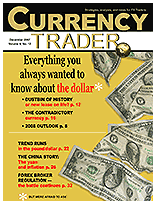
Currency Trader Magazine December 2007 issue


Free copy of Currency Trader magazine december issue is ready to download!
1. Download this issue at www.currencytradermag.com/cerb71.htm
2. Download last month's issue at www.currencytradermag.com/dyt53.htm

If you do not already have the latest version installed on your computer, download Adobe Acrobat Reader at www.adobe.com/products/acrobat/readstep2.html

Rabu, 05 Desember 2007

CAD Slumped After Rate Cut

The Canadian dollar slumped after the Bank of Canada cut overnight interest rates by a quarter-percentage point to 4.25% on its monetary policy meeting today. This decision surprised the market a bit and drove the loonie weaken to 1.0150 versus the dollar, the highest since the pair dropping below par.

Besides, the fall in energy prices weighs on the loonie. Crude oil fell to the lowest close since October on concern that the Organization of Petroleum Exporting Countries may increase oil output tomorrow.

Can You Afford Extreme Early Retirement?

This is a good read from Yahoo finance. Article provided by bankrate.com.

Could retirement before you're even eligible to join AARP be the quintessential impossible dream? Not if you're consistently disciplined, focused, driven and don't give a hoot about what the Joneses think of that beat-up Chevy in the driveway, say experts.

Whether you work to live or live to work is a question increasingly answered in favor of living by couples who have opted out of the daily grind before the traditional "early" retirement age of 50-something. What's more, they're not going quietly, but instead are springing up on Web sites and in media interviews, telling their stories and encouraging others to follow suit.

Bankrate found two such couples who were eager to share their tales of extreme early retirement: Billy and Akaisha Kaderli, and Sandy Aldridge and partner Dale Lugenbehl. Though their lifestyles are vastly different, they share many traits. Several Bankrate readers also shared their early retirement experiences.

More From Bankrate.com:

• Five Tips to Improve Your Credit Score

• Breaking a Car Lease Gets Easier

• Home Prices Fall, Sales Fall Faster

Set free to roam the world
The Kaderlis can count themselves as members of a small group of founders of the extreme early retirement trend among baby boomers. Now in their 17th year of retirement, the couple ditched their 9-to-5 jobs when they were 38 years old.

At 55, they say they would have made the same choice again, only investing sooner and with more confidence. The Kaderlis' initial $500,000 nest egg has grown steadily, partly because they hung in the stock market through the '90s boom and the historic bust that followed, and partly because they've lived on an average of just $24,000 a year. Initially, they put all their savings in a low-cost index fund.

Retiring at 38, they say, was an excellent age because they had accumulated life experiences through their careers: He was a former restaurant chef and owner, and at one time, the youngest branch manager at brokerage Dean Witter, while she continued to run the restaurant.

"We retired with youth, vigor and plenty of enthusiasm to venture out into traveling the globe. Retiring earlier, we would not have acquired enough skill or self knowledge about how we are able to interact with the world," the couple wrote from Thailand.

The Kaderlis sold their home when they retired, and remained homeless while they explored the world, spending time in the Caribbean island of Nevis, as well as in Venezuela, Mexico and Thailand. They recently purchased a small home in an Arizona retirement community, and now split their time between Chiang Mai, Thailand, and Mesa, Ariz., when not traveling to other countries.

Their Web site, www.retireearlylifestyle.com, gives them the opportunity to communicate with other early retirees, as well as educate the younger generation. Their advice to 20-somethings who want to follow the same path is simple: Save everything and stay out of debt.

Out of the mainstream
Extreme early retirement strikes a chord with people now more than in the past, says MSN personal finance columnist and author Liz Pulliam Weston. While going against the fearsome icon of the "company man" used to be part of the '60s counterculture, Weston says she's seeing a resurgence of the attitude among 20-somethings who are rejecting the consumerism that began in the 1980s. "They want more than to be chained to their desks," she says, and they have more desire to redesign their career to have more personal meaning. Sometimes that means working until 65, but shifting often to careers that suit their changing mindset.

Whether today's employees are enchanted with the idea of dropping out early or not, it's still a small group of people who can make it happen, according to Weston. "You have to be out of the mainstream to do this," she says, adding that in her experience, the successful extreme early retirees are "laser-like, and don't seem to care what people think."

Aside from an unwavering focus on their goal and an indifferent attitude toward amassing all the latest stuff, extreme early retirees can't be lumped into the same category. They run the gamut from young parents, singles and dual-income couples without children. Weston has talked to couples with as many as four children who are living in expensive areas of the country, as well as those who have no family ties and a cabin in the woods.

They share an excitement about their lives, a desire to spend time in pursuits that are meaningful to them, and often, an environmental conscience.

The simple life
All three traits apply to Aldridge and Lugenbehl, who retired more than a dozen years ago to an eight-acre parcel in Cottage Grove, Ore., with a starting nest egg of $135,000 each. They each contributed $50,000 to buy the land where they built their home, and the remainder is in CDs. They live on $400 a month, and have a health insurance policy with a deductible of $7,500.

The money has remained conservatively invested in CDs. "We like to sleep at night, so it's more important to us to know what's coming in, rather than to maximize the possible income," says Aldridge. "We've seen too many folks lose money rather than make money from their so-called investments."

Aldridge and Lugenbehl, who retired at ages 48 and 47, don't have a television and rarely eat out. Yet they don't feel like their life is lacking, says Aldridge. "We are fortunate to have found what is enough for us. I feel so totally blessed with how much we have that I can't imagine wanting more. At this point, I'd have to say it's more than enough to meet our needs and our wants."

Tips for extreme early retirement 'wannabes'
Billy and Akaisha Kaderli, the "grandparents" of the extreme early retirement movement for baby boomers, share their mantra for those seeking to follow the same path: Work hard, spend little, save a lot and spend wisely. Their additional tips include:

• Set spending and investment priorities now for the future
• Stay 100 percent out of debt, except for a mortgage
• Invest in stocks through index and mutual funds
• Use the compounding effect of time by investing early
• Seek a partner with the same financial values

Billy and Akaisha Kaderli at Kata Beach, Thailand
Aldridge acknowledges that the cost of living is lower where they are, but says they make an art form out of living well on less. They grow most of their own food, shop for clothes at yard sales, which Aldridge says is a form of entertainment for her, and find joy in small construction and gardening projects on their property.

The two cook their own meals from scratch, and volunteer to give presentations on the environmental impact of food choices, as well as what Aldridge calls "voluntary simplicity."

"Dale and I would both rather have our time," she says, "even if we end up choosing to work hard at gardening or building. At least we're the ones determining what we're going to do with our precious life energy."

Pursuing passions
Finding passion outside of a career that had become a chore is a theme among most extreme early retirees. For the Kaderlis, that meant world travel and a chance to experience diverse cultures.

"We have our youth and spirit of adventure," they wrote. "The opportunity to travel to exotic locations and meet people from foreign lands has given us a global view that no amount of money could buy."

Aldridge and Lugenbehl enjoy their day-to-day life so much that the thought of vacationing elsewhere rarely occurs to them. "We exercise faithfully three days a week, and usually take a long walk on the other four," says Aldridge. "My mother lives up here now and we take care of her. We do all the regular garden and orchard work."

The abundance of time and the freedom to choose how to spend it are the most satisfying aspects of retirement for Aldridge. "It's being able to get up each morning and decide for myself what I'm going to be doing that day. Honestly, I can't think of any downside; at least there hasn't been one for me."

Surprising reactions
Whether it's the green tinge of envy or an aversion to anyone who steps off life's predictable treadmill, extreme early retirees often face unexpected opposition from those around them.

"Back when we left our jobs, we got mostly shock," says Aldridge. "Dale's mother was a classic. She was sure we were going to go hungry and be out in the cold. That was about 13 years ago, and it's never been a problem."

"Some people have expressed envy, but we don't think we did anything they couldn't do if it really was a priority for them," she adds. "Most of our work history was part-time, and not all that highly-paid."

Aldridge says Lugenbehl's mother couldn't imagine how they would fill their time in retirement. "It was as if she thought we wouldn't be able to find things to do. My response was to ask her what she did with her time. Not another word was said because she realized that she'd never had any trouble in that regard."

The Kaderlis say that when they first retired, people treated them like they were on an extended vacation and would soon return to work. "Some thought we were committing social and financial suicide, and others projected that we were selfish or lazy since we opted out of the mandatory working world. This included family members, friends and even strangers. Our choice of early retirement was too far out of the box for them."

Think like an entrepreneur
Both the Kaderlis and Aldridge say they have always been debt free, except for the time when they had mortgages, and they avoid debt now like the plague. They also live below their means, even when their investments throw off more income.

These two actions are key to the ability to retire early, says Herb Hopwood, president of Hopwood Financial Services in Great Falls, Va. "It really comes down to the fact that you can't control what the markets are going to do, but one thing you can control is your expenses, and that's probably the biggest thing."

Hopwood likens extreme early retirement to extreme sports. "Extreme sports are risky and you must be in great physical shape. Early retirement is risky, because what you're planning is going to be for a long period of time without income...and you have to be in great financial shape."

After an initial financial plan is developed, whether informally penciled on the back of an envelope like the Kaderlis' or more formally with a financial planner, it has to be monitored and changed. Setting yourself up to receive the same income no matter how the markets perform can result in financial disaster, says Hopwood. "The objective is not to tap the principal."

Once you begin doing that, he says, it's alarming how fast principal erodes, leaving you with a smaller pot from which to draw income. A portfolio should remain fairly aggressive in equities, up to 70 percent of the total. But Hopwood cautions against a blanket approach when it comes to what's considered aggressive. "You can be aggressive in allocation, and stupid in investments." For instance, he wouldn't recommend that all the equity allocation be in biotech, or growth stocks, but in a balanced blend that will return an average of 8 percent over time.

Hopwood recommends that clients seeking a long retirement train themselves to think like entrepreneurs. The portfolio, rather than a job, is providing income, and like an entrepreneur, a retiree should be constantly watching and adjusting the rate of income.

"Too many people adjust their lifestyle to their income. That's a very dangerous thing to do."

Senin, 03 Desember 2007

Commentary: The PetroDollar Debate

By: Forex Blog

Now that the furor over the US housing crisis/credit crunch has begun to subside in forex markets, investors have turned their attention to what is perhaps the second biggest threat to the Dollar’s long term health: the PetroDollar phenomenon. In short, the price oil is denominated in Dollars and many oil-exporting nations peg their currencies to the USD. Having found themselves awash in cash, such nations are beginning to ponder greater financial independence from the declining Dollar.

The anecdotal evidence for the declining importance of the Dollar among oil-exporting countries could not be stronger. Last week two developments. First, OPEC is considering altering the way oil contracts are settled, by pricing oil in a basket of currencies rather than in USD. Next, the members of the Gulf Coast Council are considering de-pegging their currencies from the Dollar, due to rising inflation and the increasing opportunity cost of owning Dollar-denominated assets.

Actual data, on the other hand, suggests that OPEC may be moving in the opposite direction, towards a greater dependence on the Dollar. The US remains the most popular destination for petrodollar investments, attracting 55% of all such investment capital. Europe comes in at a distant second, attracting just 18%. Plus, in the last year, oil money has been used to make several widely-publicized investments in American investment groups, including a recent $7.5 Billion investment in Citigroup by the Abu Dhabi Investment Authority.

The evidence is certainly nuanced. In all likelihood, OPEC will make good on Iran's failed attempt to sell oil denominated in Euros by linking oil to a basket of currencies. In their own words, “oil is being sold in a currency whose value was eroding by the day.” At the same time, the US is still the home of the world’s best capital markets, from the standpoint of stability and risk. Thus, while it’s possible that some or all of the members of the GCC will de-peg their currencies from the Dollar, any relative decrease in Dollar-denominated investments is likely to be passive, rather than active.

USD Softer, Awaits Data

The currency market has much to digest this week as traders look ahead to monetary policy decisions from several central banks, including the BoC, RBA, BoE and ECB. The greenback relinquished some of last week's gains in early Monday trading, slipping against the sterling and yen. The major currency pairs will likely be dictated by a combination of sentiment over global interest rate differentials as well as any new revelations from the subprime debacle and credit crisis.

Fed Chairman Bernanke's comments last week heightened market expectations for a December rate cut. It remains unclear however, whether the anticipated ease will be a 25-bp or 50-bp cut.

Sabtu, 01 Desember 2007

Fed to Cut Rates Next Month?

In recent speeches, two high-ranking officials from America’s Federal Reserve Bank gave conflicting indications regarding the likelihood of rate cuts next month. Both officials were deliberately ambiguous in their speeches, though one went so far as to rule out a rate cut while the other hinted at its inevitability. Nonetheless, analysts used the speeches to buttress their conclusion that a rate cut is probable. In fact, the futures market has priced in a 94% chance that rates will be cut by 25 basis points at the next meeting, on December 11. Likewise, it seems a rate cut has already been priced into the USD.

Jumat, 30 November 2007

Yen Fall as Global Stocks Surge

The yen fell versus high-yielding currencies as global stocks rebounded this week. Carry trades came back to the market as investors regained their risk appetite.

The greenback gained as US corporations squared positions to realize profits on financial statements by the end of the month. The euro dipped to lower 1.46 versus the dollar, and the sterling fell to below 2.06.

The euro zone CPI rose at a faster-than-expected rate of 3%, increasing the case for an unchanged rate decision at ECB¡¯s next policy meeting. In the medium term, the euro is more favorable than the dollar in terms of the interest rate outlook.

US personal income rose at 0.2% in October, below the estimate and the previous reading of 0.4%. Personal spending also fell to 0.2%, lower than the expectation of 0.3%. A key inflation measure, core PCE index, remained at a monthly rate of 0.2% as expected. Chicago PMI rose from 49.7 to 52.9 in October, better than the estimate of 50.3.

The situation the Fed faces now is the inflation is contained and the economy is slowing. US futures showed traders are pricing in a 68 percent chance the Fed will cut its interest rates by a quarter-percentage point to 4.25%

Fed Chairman Ben Bernanke said yesterday on the Charlotte Chamber of Commerce meeting that resurgence in financial market in these two weeks dimmed US economic outlook. The dollar was under pressure after his comments.

The six members of the Gulf Cooperation Council may relax their fixed exchange rates to the US dollar at a meeting next Monday.

EURUSD will face interim resistance at 1.4650, followed by 1.4680 and 1.47. Additional ceilings will emerge at 1.4750, backed by 1.4780. Support starts at 1.46, backed by 1.4580, 1.4550 and 1.4520. Subsequent floors are eyed at 1.45.

GBPUSD encounters interim resistance at 2.06, backed by 2.0650 and 2.0680. Subsequent ceilings will emerge at 2.07, followed by 2.0730 and 2.0750. On the downside, support begins at 2.0550, followed by 2.0520 and 2.05. Additional floors are eyed at 2.0470, backed by 2.0450 and 2.04.

USDJPY encounters interim resistance at 111.30, backed by 111.50 and 111.80. Subsequent ceilings will emerge at 112, followed by 112.50 and 113. On the downside, support begins at 111 and 110.80, followed by 110.50. Additional floors are eyed at 110.20, backed by 110 and 109.50.

Kamis, 29 November 2007

Mid Term View

The EUR/USD has already dropped to key support at 1.4725 and has bounced back up. The pair is most likely going to continue moving in a sideways range between 1.4725 and 1.4875. If some other piece of bullish USD news does happen to come out within the next day or two, the EUR/USD may drop down to support at about 1.4625, but that is where the buck stops.

You will see similar movement with the USD versus the Japanese yen (JPY) and the CHF. Both the USD/JPY and the USD/CHF have risen to key levels of resistance and will most likely turn back around and fall back into sideways trading ranges.

Don't try and chase this bullish USD move just yet. You will find some trading opportunities as these pairs trade in their ranges, but you should keep you time horizon on your trades a little shorter.

Selasa, 27 November 2007

USD Drifts Lowers

The dollar traded lower against the majors at the start of the week, relinquishing the 2.07-level against the sterling and falling near the 118-mark versus the yen. Given the heightened uncertainty stemming from the ongoing credit crisis, growing fears of an imminent recession in the US economy continue to weigh on the greenback. With further deterioration in the housing market and consumer confidence, the key question among dollar bears is whether another 25-basis point rate cut from the FOMC is forthcoming.

Although the Fed adopted a neutral tone in its October policy statement while revealing an uncertain outlook in the minutes, further turmoil in the financial markets and accelerated deterioration in economic fundamentals will likely force the FOMC to ease again in December. Particularly key in the next policy decision will be the fragile combination consumer confidence, inflationary pressure, and economic growth data. In the Tuesday session, traders will focus on the Conference Board's November indication of consumer confidence, seen falling sharply to 91.6 versus 95.6 from October. Also due out this week will be October durable goods orders, existing home sales, a preliminary reading on Q3 GDP, October new home sales, October PCE and Chicago PMI. Interestingly, the data for Q3 GDP are expected to reveal resilient economic growth, expanding at a robust 3.5% y/y and 4.8% q/q, up from 2.6% y/y and 3.9% q/q, respectively. The Fed's Beige Book, slated for release on Wednesday will provide further insight into current conditions in the housing market, capital expenditures.

ECB President Jean-Claude Trichet reiterated that sharp and abrupt moves were disruptive to the global economy. He said that he was not campaigning for the international use of euros, adding that he has 'noted with great attention' the statements from US officials' such as Treasury Secretary Paulson that the strong dollar is in the interest of the US. There is no doubt that the euro's rapid ascent against the dollar and yen has started to impact the Eurozone economy. We expect more government jawboning to take place, but place little stock in any concerted intervention efforts to inflate the beleaguered greenback.

Sabtu, 24 November 2007

Weekend EUR/CHF

On my previous post. I stated that EUR/CHF pair should continues its bear trend once price on 4h chart closed below the 74.6% Fibo of its major swing up at around 1.6330.

I have to make a correction there. Since the Fibonacci we are looking at is from a major swing, it is appropriate to check the price action at a bigger time frame.

Price did closed below that level on 4h chart, but on the daily chart... it didn't. The last candle/bar on the dailies ended with a pin bar. If on monday, the closing bar is higher than last friday's closing price. The pin bar will be confirmed.

However, I also placed a sell stop order 5 pips below friday's low. This is to safeguard if ever EUR/CHF continues to drop on Monday.

On friday, the fundamental standpoint supports the further carrys unwinding view. However, just yesterday I heard Brazil central bank start to intervene by purchasing massive quantities of Dollar-denominated assets in the open market. Canada and Japan are at risk, hope they follow suit.

Kamis, 22 November 2007

Carry Trade Continues to Suffer

The carry trade is still unwinding, if not coming to an outright end; the result is that the Yen is belatedly joining the ranks of the rest of the world's major currencies, which have risen tremendously against the Dollar. The reason for the sudden weakness in the carry trade (i.e. Yen strength) is volatility. The US "credit crunch" began to significantly effect US bond and stock market valuations almost four months ago, but the full impact still hasn't been felt. The latest development concerns the quarterly earnings release for Freddie Mac, an American company whose main purpose is to provide liquidity to the US mortgage market, through the buying and selling of mortgage-backed securities. However, Freddie Mac is now bleeding money, and while it is unofficially guaranteed by the federal government, investors are seriously questioning its ability to prop up the ailing market for housing CDOs. And this uncertainty is causing investors to eschew risk, in short, to abandon the carry trade in favor of more traditional forex strategies.

EUR/CHF 1h just closed below the 74.2% fib (1.6330) While 4h chart haven't confirm it yet but probably will. I'm looking at 1.6176 as the target if ever bear momentum increases. Though 1h and 4h chart now is at oversold level, so its hard to tell.

If anyone out there hedging long on EUR/USD against USD/CHF. You may consider cut some losses and hold the remaining, or directly short the EUR/CHF pair if you think it will fall using technical analysis.

Selasa, 20 November 2007

Will the Fed Hold Rates on their Next Meeting?

In a recent speech, a prominent Federal Reserve Board governor strongly hinted that the Fed would maintain US interest rates at current levels at the Fed's next meeting. The Fed is caught in the delicate position of trying to balance economic growth with the specter of inflation. While technically the Fed is always trying to meditate between these two outcomes, its current position is especially tenuous since the US economy is trending downward while inflation trends upward. Despite the emphatic claims to the contrary, futures markets are still pricing in a rate cut, setting the stage for a showdown with the Fed. As usual, the Dollar's fate hangs in the balance.

Read more at msnbc

Jumat, 16 November 2007

Yen Carry Trade: Going Strong or Coming to an End

Yesterday, the Financial Times ran two stories on the Japanese carry trade, painting a seemingly contradictory picture. The first article profiled the rise in the number of retail forex accounts in Japan, projected to reach 1 million by year-end. More amazing is the fact that many of these traders are actually quite sophisticated, taking long and short positions in multiple currencies, though of course the most popular bet remains the carry trade, which involves going short the Yen and long a higher-yielding currency. Meanwhile, as the second article expounded, the Yen carry trade is under pressure, having appreciated nearly 5% against the US Dollar, Euro and Australian Dollar. The cause is certainly volatility in global capital markets, precipitated by what has been termed a "credit crunch," itself caused by the slump in housing prices. The hoard of Japanese retail investors may have to reverse their positions...

Read More: Pressure grows on yen carry trades

Data Caps USD Gains

The greenback posted its largest weekly gain on a trade-weighted basis in a month despite relinquishing its grip in Friday trading. Nevertheless, lingering fears over credit conditions and the credibility of banks' balance sheets continue to plague the currency. Accordingly, the currency market will continue to be closely correlated with equity market moves - particularly the trajectory of the carry trade pairs, amid times of heightened volatility.

Economic data released earlier in the session derailed the dollar's rebound against the majors, pushing it toward session lows versus the euro and sterling.

Fed Board Member Kroszner downplayed the prospects for another FOMC rate cut over the coming year, saying "the current stance of monetary policy should help the economy weather the rough patch during the next year, with growth then likely to return to its longer-run sustainable rate". Fed members have been tempering market expectations for another 25-basis point rate cut at the December FOMC meeting particularly after market sentiment in October fully discounted an ease despite the actual decision being much closer than expectations suggested.

Kamis, 15 November 2007

Why China Should Not Dump the Dollar

by: Forex Blog

In fact, China may have to increase its exposure to the dollar, according to the comments of Brad Setser of the Council of Foreign Relations: "In my mind, so long as China resists more rapid appreciation of the renminbi versus the dollar, it's rather difficult for China to diversify in any meaningful way against the dollar. If China really started to diversify away from the dollar, I think it's a big enough player that it would put downward additional pressure on the dollar."

And additional downard pressure on the USD should be what China is trying to avoid. China, being the largest exporter to the U.S. does not want to see appreciation of its currency against the USD, as that would make its goods more expensive (and therefore less competitive) in America.

In fact, Setser goes on to say that in order to prevent the USD from sliding even further downward against the RMB, China would have to not only retain its present stock of USD, but in fact buy even more.

Read more: Can China dump the dollar?

Rabu, 14 November 2007

Do Trading Systems Really Works?

(FREE e-book to download at the bottom)

The answer may surprise you.

As I have met with and spoken to couple of traders this year, many have asked if my and other Forex Trading Systems really work.

Before we get into that, let's first establish what a system is. Someone once told me that a system can be summarized in a powerful acronym as:

S ave
Y ourself
S tress
T ime
E energy
M oney


Think about it... Saving Yourself Stress, Time, Energy, and Money sounds great, right?

The definition of system at dictionary.com says, "A group of interacting, interrelated, or interdependent elements forming a complex whole"

So let me ask you a couple of questions:

What systems if any do you currently use to decide when to get into and out of a trade? And where, or if, to include stop-losses and/or profit targets?

How about your system for money management?

What about your system for optimizing your trading mindset?

Are you systems working for you? Are you getting the results you want?

You may notice that there is room for improvement in those areas.

One thing's for sure. Without the right trading systems in place, it is very difficult, if not impossible, to achieve consistent success. This leads to the next question I hear frequently:

So which or whose Forex trading system works best?

The answer to that is very similar to me being asked which time management system works best. Meaning...

The best system for time management and Forex trading is dependant upon you, your habits, and what you feel most comfortable working with and sticking with.

Analogy of two people who have time management systems:

1. One person swears by a Franklin-Covey Day Planner and feels that anyone using anything else must be a fool.

2. The other person uses a Treo 650 PDA and feels that anyone not using a Treo for their time management is a fool.

The true answer is that as long as it produces the desired result for the person and they are comfortable in using it and committed to using it, both are using the best system for them.

Same holds true for you and your Forex trading business.

You'll hear people talking about how great their system or product is and how great that other system or product is...

BUT YOU HAVE ONE JOB AND ONE JOB ONLY...

And that is to find the system that works best for you, feels right for you, that you know you can remain committed to following, and you are able to produce the results you desire from it.

Because here's the truth about ANY system... and the answer to the question posed to me at the title of this post:

Systems will only work for you IF and only IF the system is a fit for you and you work the system...religiously!

As I'm writing this I glanced over to my bookshelf and see a glaring example of this in action in a book by Bill Phillips called "Body For Life".

No one with their before and after picture results shown on the cover and inside of that book were half-committed to that system... or were just going to give it a try. They were fully and whole heartedly committed to start, continue and complete that system... and the results show that very clearly.

Sad fact is that millions of others started with just as much fire and determination as the ones seen on the book, but there's one difference between them and the ones on the cover...they didn't fully and completely follow the system.

Back to Forex Trading...

For instance many of our clients went from having systems that were getting them nowhere but stressed out and broke prior to meeting me. They were ready to throw in the towel but after 'seeing the light,' so to speak, it finally hit them.

They made the changes necessary, took the steps they were directed to take, followed through down to the nitty gritty detail, and are now achieving tremendous success.

Do as they do, and you'll be on the path to success and wealth. Remember, Forex trading is a business. If you treat it as such, you'll be further along than 95% of the traders that never make it.

Before I end this post, I'll introduce you with one of the trading system I'm demoing now (well... aside from
Forex-Killer
) and the trusted True North Hedge for my live trade.

It is the Forex Profit Pro system. Click HERE to know more about it.

They are giving away a $1 for 10 days free trial, which I personally using right now, and its doing well. Lots of video streaming to guide you. And two thumbs up for the support team.

But before you check the system. Here's a FREE ebook that you can download from them. Click HERE!

GBP Pounded by BoE

by Korman Tam

The greenback was mixed in the Wednesday session, advancing versus the British pound and the yen while struggling against the euro and Aussie. With the exception of the sterling, the higher yielding currencies rallied against the yen as speculators continued to jump back into the carry trades following the sharp unwinding of recent sessions.

Economic data from the US were largely softer than expectations. The October PPI increased by 0.1% on a monthly basis, down from a 1.1% increase previously while the annualized PPI jumped to 6.1% from 4.4% previously. Core PPI was flat on a monthly basis versus 0.1% previously, but the yearly core PPI jumped to 2.5%, from 2.0%. Meanwhile, retail sales for October were weaker with the headline report inline with estimates at 0.2%, but down from the previous month at 0.6%. The excluding-autos retail sales figure missed expectations, down to 0.2% versus 0.4% a month earlier.

Bank of Canada Deputy Governor Jenkins expressed concern over the rapid appreciation in the Canadian dollar, saying the recent rise is stronger than historical experience have suggested. He said that Canada has been bearing a disproportionate share of adjustment in global imbalances. He warned that if the Loonie remains at current levels, there will be increased risks of significantly lower inflation and output.

Dow Skyrocket

Nov. 14- Dow Jones made a big recover since yesterday after the last week drop, so are the carrys. This is a good sign for the True North Hedge strategy.

Photo Sharing and Video Hosting at Photobucket

My accounts has recovered a bit, but are still in a drawdown.

Selasa, 13 November 2007

$20 Million Dollar Requirement for FDMs?

The business of forex currency trading is going to change dramatically in the next 6 months.

Read this post from Francesc's blog at FXStreet.com.

And here's an excerpt from the president and CEO of the National Futures Association to Congress in September:

Congress should amend Section 2(c) of the Act to require FCMs acting as counterparties to retail forex transactions to maintain minimum capital of at least $20 million.
That means that most forex dealers that you do business with are going to have to put up a significantly bigger amount of money to stay in business. The only pure forex-dealing firms that could survive right now under this requirement would be FXCM, Oanda, and GFT.

Carry Trades Rebound

The dollar's rebound stalled in the Tuesday session, relinquishing the 2.07-level against the British pound as traders jumped back into US equities while propping up the carry trades. The moves in the currency market remain closely linked to risk aversion thus warranting particular attention to any new revelations from the subprime meltdown and global equity bourse moves.

Economic data due out from the US tomorrow will see retail sales, PPI and CPI. It will be important to gauge the impact of the deteriorating housing market on the US consumer to determine the extent of any spillover effects on consumption. Retail sales for October are seen down at 0.2%, while the excluding autos figure is down 0.3%.

The Bank of Japan, as expected, left monetary policy unchanged at 0.5% when it announced the results earlier in the session. The Bank voted 8-1, with BoJ Board member Mizuno voting against the unchanged decision. BoJ Governor Fukui stressed that “if adjustments in the US housing market worsen and negatively affect private consumption and capital investment, the global economy would deteriorate”, which would inevitably be detrimental to Japan’s economy. Further, Fukui said that market adjustments have been within the bank’s assessment, adding that there is no preset schedule for future policy tightening. We continue to expect the BoJ to leave policy unchanged for the remainder of the year and do not anticipate any changes until Q2 2008.

Japan PM Fukuda expressed concern over the yen’s valuation, deeming recent appreciation as too fast and cautioning speculators. Fukuda said the yen’s strength poses a problem for the short-term, adding that any sudden change in exchange rates is undesirable. The jawboning is unlikely to deter speculators from dumping carry trades during periods of heightened risk aversion, the primary source of strength for the yen.

11.14 Analysis

EUR/CHF
1,6439. EUR CHF is in an downtrend directed by 1H exponential moving averages. It is in a consolidation after the last bearish movement. The volatility is low. Bollinger bands are flat. 4H Trend Indicator is in a bearish configuration. 4H Stochastic crosses and gives a positive signal. The price should continue to consolidate. The price should find a resistance below 1,6470. If the resistance is broken then the target will be 1,6550.

Resistances
1,6450 - 1,6470 - 1,6500
Supports
1,6420 - 1,6380


EUR/USD
1,4611. EUR USD is in an uptrend supported by 4H exponential moving averages. EUR USD is in a range between 1,4510 and 1,4750. The volatility is high. Oscillators are neutral. The price should continue to consolidate. I won't take a position.

Resistances
1,4630 - 1,4730
Supports
1,4570 - 1,4520

JPY Soars amid Carry Trade Unwind

by Korman Tam

The underlying theme in the currency market for recent sessions has been heightened risk aversion with sharp swings in the yen pairs. Carry trade unwinding dominated market moves, thereby benefiting the greenback as it rallied against the euro, sterling and Aussie. With global equity bourses remaining under pressure, traders pushed the euro/jpy beneath the 159-level and gbp/jpy below the 226-handle. The dollar's sharp gains were also a result of thin trading conditions with Canada and the US bond market closed in observance of the Veterans Day holiday.

Economic data slated for release this week will shed light on global inflation conditions, including the UK, Eurozone and US. Also to be closely focused on will be retail sales reports from the US and UK. Markets will closely scrutinize the consumption reports for clues of pull-back as a result of steadily increasing energy costs.

Gold Decline Highlights Intensity of Turmoil

by Ashraf Laidi CMC Markets Analyst

The intensification of the global equity sell-off is underlined by the $30 per ounce decline in the price of gold from last week’s $844 high as the global market route is reaching towards Asian borders, hence, threatening the notion of global growth and robust demand for commodities. A sharp reduction in risk appetite is waging a broad assault on carry trades, which previously backed high yielding currencies, gold and equities. Reports that Hong Kong-based HSBC bank will announce $1 billion in bad debts from US mortgages and China ’s decision to raise the reserve requirement for the ninth time this year have been catalysts to the overnight 3.9% decline in the Hang Seng Index following last week’s 5.5% selloff.

Unlike in recent equity market losses, which were confined to the US markets, the current market route has reached over to Europe and Asia (especially China ), which is the main catalyst to the sell-off in gold and oil.

Sharp reduction in risk appetite is boosting the dollar all major currencies with the exception of the Japanese yen as markets remain damaged by persistent flow of negative news on the banking sector and recent signs of slowdown from the previously robust technology sector. Thursday’s Congressional testimony from Fed Chairman Bernanke was notably dovish, triggering a steepening in the yield curve (widening of the 10-2 year spread), implying higher odds of further rate cuts.

While falling gold prices are a result of sharp unwinding of carry trades and a higher risks of a slowdown in China –as reflected in falling stocks and tighter monetary policy in China—oil prices are also falling on a weaker assessment for world growth, with the US in particular. WTI crude oil fell 82 cents to $95.50 per barrel, after hitting an all time high of $98.62 pb. Although the Saudi and Kuwaiti oil ministers raised the possibility of raising oil output, it is unclear which meetings they referred to. OPEC’s summits on Nov 17-18 and on Dec 5.

Euro drops on risk retreat

EURUSD loses ground as the retreat in risk appetite is increasingly becoming a global phenomenon, raising doubts of a slowdown in Europe . But even if Eurozone banks go unscathed from the reporting of mortgage-related losses, the euro comes under pressure as fund managers unwind the dollar-selling positions to meet losses in equity portfolios. Comments from Germany’s Finance minister indicating no cause for concern over the strong euro went largely ignored in the current turmoil, but the statements is an important signal from policy markets and politicians reflecting the tacit support for the strength of the currency.

Widespread risk aversion into the US session will call up interim support at 1.4525. Key foundation stands at 1.4475, which can be realized in the event that gold breaks below the $806 support. We anticipate further gold losses towards the $800 support, which is the 38% retracement of the Oct 4 low to the Nov 7 high. EURUSD upside capped at 1.4620.

EURGBP surges to a fresh 35-month at 70.46 pence as sterling’s high yielding status is pummeled during the current global turmoil. Further upside seen caped at 70.70, but any actions aimed at shoring up appetite (such as an emergency Fed cut or rumors of such) could weigh on the cross. Support climbs towards 70.20.

USDJPY breaks below 110 on Machimura’s green light

Comments from Japan's top government spokesman Nobutaka Machimura indicating that Japan would not intervene in currency markets and that "It's wrong to think a high yen is something bad for the Japanese economy” have accelerated the yen’s rally. The latest 200-point drop in USDJPY reflects the Machimura comments as well as the accumulation of past USDJPY net longs, which are now being unwound as a result of cascading execution of stops, especially amid the execution of margin calls. Another factor preventing Japan from intervening is the emerging global opposition against currency interventions, as the US and Europe wage their campaigns in pressuring China to refrain from dollar buying interventions.

USDJPY eyes the 108.97 low, which is the double bottom in May 2006 and September 2005. While subsequent losses are seen stabilizing near 108.20, there are no major technical support levels until 106.15, which is the 61.8% retracement of the move from the 1995 low to the 1998 high. While we do not rule out upward corrective moves to 109.70 and 110.50 during the US session, it is important to note that the lows in the European sessions have never proven to be the lows of the day in the current year.

Sterling drops 2 cents to 2-week lows

Dubious fundamentals in sterling have caught up with GBPUSD as the high yielding pair is under threat. We have long pointed to weakening UK fundamentals as the reason to sterling’s continued losses against non-USD currencies. The decline in gold and oil as well as the extension of equity losses towards UK shores is expected to prolog the correction towards $2.0635. A blaze in East London --near the financial district—is also weighing on sterling.

We could see sharper declines in the currency in the event that Tuesday’s release of Oct CPI remains under 2.0%. Wednesday’s release of the Bank of England inflation report and Thursday’s release of the Oct retail sales (expected at 0.1% from 0.6%) will also be crucial in determining the prospects for the currency and central bank policy. Upside capped at $2.073. Key support seen at 2.0630, followed by 2.06

Not a Short Term Strategy

Since the inverse hedge strategy I'm using is highly depends on carrys trades of its crosses. I'm posting this article I gathered from John Jagerson of pfxglobal.

"The carry trade is under attack today but from analysts not prices. Certainly, most carry trade portfolios, including one of my own that I manage, are eating some losses this morning but the press on the issue is extremely negative. It seems counter intuitive to me to assess the health or strength of what is essentially a long term strategy based on short term movements in the market. Additionally, the definition of the "carry trade" as one in which you are simply short the JPY is way to narrow. As the JPY hits all new highs against the USD, it is a good time to think about what this strategy really is and why it works".

"The Carry trade is an opportunity in any market that offers yield differentials between similar assets. In the forex, the GBP/JPY, AUD/JPY or NZD/JPY offer a very wide differential but should not be the definition of this strategy. In the forex alone other currencies like the CHF, SEK and USD, to name three, can play a role in a managed carry trade portfolio. If an investor is actually trying to leverage the difference between yields and play the market's propensity to rise in favor of higher yields, their outlook should be diversified (which the three pairs I listed above are not) and long term. As the market changes the carry trade portfolio should also change but not the strategic concept itself".

As for an update: My portfolio as recovered a bit from a week of drawdown. The bearish moves of eur/chf and gbp/chf has slowed down, which is a good sign that it might reverse from here. EUR/CHF bouncing off its 74.6 fib supports this insight. I'm just waiting for a breakout from this consolidation.

Senin, 12 November 2007

How to trade economic news

Many traders think that watching the news is very important and on the surface that would seem to make perfect sense but…

The problem lies in the fact that there are can be hundreds of new economic and political news stories coming out around the clock. With that many, it is easy to get information overload and become so paranoid that it is impossible to take a trade.

Even if you spent every waking second reading the business newswires, you still wouldn't know everything. In addition you can never be certain how the news will effect the market. To compound the problem further, you can be certain that there will always be market insiders that get the news before you. The bottomline is that no matter how well informed you are, you can never know everything.

Until a trader learns to accept this, they will have a constant sense of uncertainity about whether they are making the right decision or not.

Since I am a technical trader I don't worry about news as I view it as a force that helps create the necessary volatility in the markets. Without volatility there is little movement and follow through.

Another reason you can't worry about news too much is because we can't always control when it comes out. For example say you are in a trade and war breaks out or another 9/11 type event occurs. Those type of events thankfully are very, very rare, but the bottom-line is we have no control or advanced warning over unforeseen events. The only thing we can control is to place protective stops to minimize our losses. (Note: Stops may not protect you if catastrophic news hits the market)

Also don't forget that really good unforeseen news can cause losses for you if you are trading in the wrong direction.

What I mean is… Say you are going short in a stock because the company is not doing well based on its performance over the past year. Even though your analysis is right, there is always a possibility that really good unexpected news within the company could cause a rapid reversal of the down trend and cause you to have significant losses.

One last thing to remember is that there will be times you are in a trade and news hits the markets that may quickly add another few hundred pips to your profit level. Many traders only think of unexpected news as a source of losses.

With all this said, it doesn't mean I throw all caution to the wind regarding news either. Anytime there is a major news event coming out I will either exit the trade I am in or wait to initiate a new trade.

Minggu, 11 November 2007

EUR/CHF, EUR/USD & GBP/USD Analysis for Monday

EUR/CHF- Might find a way to touch 61.8 fib of the previous up swing. 1.6422 to 1.6400 before a possible nice rebound.

Resistances
1,6505 - 1,6560
Supports
1,6470 - 1,6450


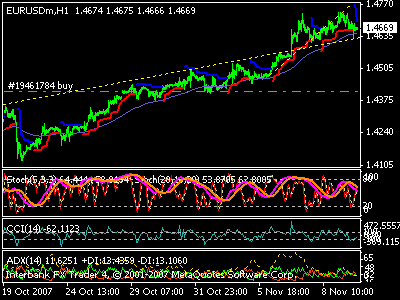
EUR/USD- Just bounce off a major trendline. an uptrend supported by 1hr Stoch and CCI. The volatility is high. A parallel channel can be drawn to form a trend. My trend indicator 4hr and daily is in a bullish configuration. The price should continue to consolidate with bias to the upside. The price might continue to move in 1,4660 - 1,4730 range. I won't take a position. The risk/reward ratio is too high to take a position.

Resistances
1,4730 - 1,4750
Supports
1,4670 - 1,4615


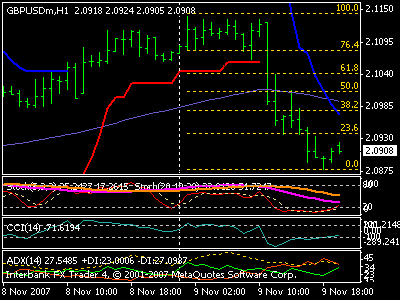
GBP/USD- Just fomed a pin bar 3hrs before the market close of last week. Trend bias is bull on higher TimeFrames. 1hr Stoch and CCI crossed significant levels up.

Trade suggestion: Open a long position as soon as the market open, set TP at 38.2 fib and 2nd TP at 50 fib of the last swing down. That's 2.0977 and 2.1009. SL at 2.0800. Adjust SL to breakeven if price passed 2.0940. Trail stop the 2nd position if you want. Trade at your own risk.


Best time to use the True North Hedge. Learn it HERE!

Fed Comments Pushes The Dollar Down

A recent speech by Ben Bernanke, chairman of the US Federal Reserve Bank, sent the Dollar spiraling downward to fresh lows against all of the world's major currencies. This is perhaps surprising, given that Bernanke used the speech to warn that higher-than-expected inflation may drive the Fed to hike rates, which is exactly what Dollar bulls wanted to hear. The downside of the speech, reflected in the markets' reaction, was that the primary cause of the inflation is rising oil prices, would could plunge the US economy into stagflation: slow growth and high inflation, an unenviable position if there ever was one.

Sabtu, 10 November 2007

Yen Surges On Risk Aversion

Last week, The yen rose sharply across the board on rising concerns over the credit market. The currency hit a 1 ½ year high at 110.52 versus the dollar. The euro dropped from 166 to just above 162 against the yen, and the sterling slumped 7 big figures to as low as 231.20 versus the yen.

Fed Chairman Bernanke said yesterday in Congressional Testimony that the contraction in housing market may continue to drag the economy and the nation's economic growth is likely to slow down noticeably. His comments raised worries over the housing and credit market, increasing the case for another quarter-percentage point rate cut in December. For fear of further losses in banks from subprime related investments, investors cut back risk appetite and therefore wound the carry trades.

How to take advantage after the carrys unwind? Learn it more HERE!

Supermodel Bundchen Joins Hedge Funds Dumping Dollars

Nov. 5 (Bloomberg) -- Gisele Bundchen wants to remain the world's richest model and is insisting that she be paid in almost any currency but the U.S. dollar.

Like billionaire investors Warren Buffett and Bill Gross, the Brazilian supermodel, who Forbes magazine says earns more than anyone in her industry, is at the top of a growing list of rich people who have concluded that the currency can only depreciate because Americans led by President George W. Bush are living beyond their means.

Even after the dollar lost 34 percent since 2001, the biggest investors and most accurate forecasters say it will weaken further as home sales fall and the Federal Reserve cuts interest rates. The dollar plummeted to its lowest ever last week against the euro, Canadian dollar, Chinese yuan and the cheapest in 26 years against the British pound.

Self-Control: Expanding Your Limits

by Mark Turcotte

Winning traders are "disciplined." They don't allow their emotions or impulses to get the better of them. They approach the markets in a way that allows them to trade skillfully. As one professional hedge fund manager put it,"[Trading is] just like sports. The difference between the physical abilities of the top pros is virtually nothing. But the mental difference is huge. The guys at the top...are mentally
consistent...It's the same thing in trading. The psychology of professional traders allows them to stick to their strategies. They don't stress out as much as the rookie traders. I still make mistakes once in a while, but not as much as I did... It's impossible to eliminate all of it. I still fall victim to doubt and other
psychological pitfalls. I still have major doubts and stress starting to come in...As far as dealing with the ups and the downs, this requires a combination of research and experience. After a while, making or losing a lot...becomes second nature...there's a sense of normalizing the ups and downs...you don't get as excited over them. It's just an event...After a while, it's just a cycle." Maintaining
discipline and control doesn't mean that winning traders don't have a passion for trading. Of course they do, but at the same time, they don't allow their emotions or impulses to overwhelm them. Over time, and with a vast amount of experience, trading becomes commonplace and one naturally approaches trading with the proper mental edge.

Trading requires discipline. A trading plan is of little value if you abandon it prematurely. The disciplined trader executes a plan and controls his or her emotions until the plan comes to fruition. Although most traders intellectually understand the importance of discipline, many would-be traders have trouble staying controlled at critical moments of investing.

Drs. Baumeister, Muraven, and Tice (2000) argue that self-control is a limited resource. When we show self-control in one area, such as trying to control our diet, we don't have energy left to show self-control in other areas, such as concentrating on following our trading plan. Now, that's not to say that one should abandon dieting in order to be a disciplined trader, but it's useful to consider that humans have limits regarding their ability to show self-control. Self-control is like a
muscle. If you try to lift too much, you'll wear yourself out and you'll need to get some rest before you can try lifting a heavy object again. The same can be said of self-control. In a recent review of the scientific literature, Gailliot and Baumeister (2007) document a vast array of evidence that shows that after participants complete one laboratory task on self control, they have difficulty performing a second task. For example, if you try to avoid eating your favorite snack, studies have shown that you are likely to give up when trying to complete a frustrating task. Self-control is a limited resource. Just like when you work out. If you work out too long, you need to rest a little while before doing physical exercise.

Stress can reduce your ability to maintain self-control while trading. Coping with stress saps up the limited psychological resources you have to devote to self-control. A study by Oaten and Cheng (2005) illustrates how stress limits self-control. They randomly assigned participants to complete a task either under stress or under no stress.

When participants were stressed out, they had difficulty completing the laboratory task. They also reported having difficulty keeping up with demands in their everyday lives, such as controlling their diet or keeping their house clean.

These findings suggest that self-control is like a muscle that can become worn out. If you try to trade while overly stressed out in your personal life, you'll have trouble sticking with your trading plan, especially if you are a novice trader who has relatively little experience maintaining discipline when your money is on the line. It's important to be aware of your ability to maintain discipline. Just like
a muscle,if try to do too much, your self-control "muscle" will fail. Rather than over-taxing your limited self-control resource, it's vital that you start out slow and work up to gaining more self-control.

How do you build up self-control "muscles"? First, minimize daily stressors, or if you have a lot of stress, cut back on your trading until you can alleviate stress and free up psychological energy in your personal life. Second, do self-control workouts. The more practice you have at self-control, the more likely you'll be able to stay disciplined while executing a trade. You might try a visualization exercise in which you imagine yourself executing a trading plan and maintaining self-control under a variety of scenarios.

The winning trader is the disciplined trader. But discipline isn't easy to come by. It's vital that you acknowledge your limitations. Don't set yourself up for failure by thinking you can be disciplined all the time. Like everything else, discipline takes practice. The more you can build up your self-control "muscles," the more easily you can execute your trading plans with grace and decisiveness.

Kamis, 08 November 2007

EUR/CHF Outcome

A few days back, I said it here that eur/chf has a greater chance to drop to the 50% or 68.1% fib of its last major swing up.

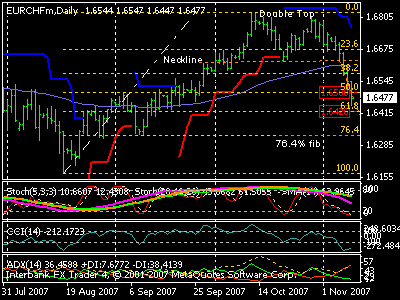
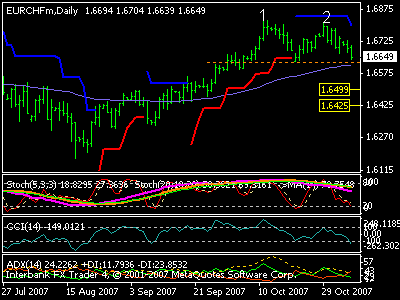
Here's the same chart I posted last Nov. 6:


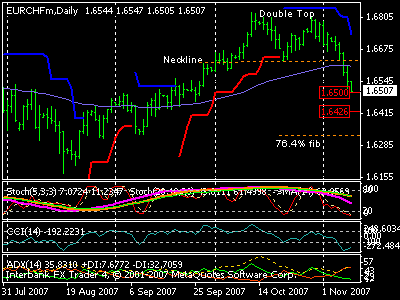
And here is the outcome of that analysis. A perfect double top formation.


The graph shows big players are cutting their risk appetite to high yielders. A steep decline with great momentum can pull the price down to 68.1%. Break of 76.4% fib will curtail the bull.

Price is now at the 50% fib, might bounce off from here for awhile before continues its bearish trend. ..... I hope not.

So, traders who are using (long) inverse hedge strategy. If you are trading more than 20% risk, cut your losses by 50% and hold the rest. If it is less than 10% risk you're trading, Take a vacation! Come back in a week.

These are normal. It is the much needed correction after a long way up.

To know more about the inverse hedge, Click here.

Dollar Fell on Bernanke Testimony

The dollar slid further across the board after the Fed Chairman Bernanke testified in front of the Congress. The euro hovers just below the 1.47 level against the dollar, while the sterling climbed to as high as 2.1116 versus the dollar. The yen also gained against the dollar from above 113 to a session low at 112.07.

Bernanke today warned that the housing sector conditions may become more severe, increasing worries over the housing and credit issue. He also said the nation¡¯s economic growth may slow noticeably, raising expectations for further rate cut. Interest rate futures showed traders are pricing in an 82 percent chance that the Fed will cut interest rates by a quarter-percentage point in December.

The Euro and sterling remains robust against the dollar after the European Central Bank and the Bank of England left their interest rates unchanged at 4.0% and 5.75% respectively as expected today.

The ECB and BOE postponed rate hikes they planned earlier because of this summer¡¯s global financial market turmoil triggered by US credit crunch. Before the extent of damage from subprime loans related investments are clear, the banks need to keep cautious and do not rush raising rates though the inflation seems to be elevated. In the short term, these two central banks are more likely to keep their benchmark rates unchanged.

While global equity market fell today, investors cut their risk appetite. The yen, as a low yielding currency, benefited from the decline in carry trades.

EUR/CHF 11.8 Analysis

1,6595. EUR CHF is in an downtrend directed by 1hr 72EMA. The volatility is low. My trend incicators are in a bearish configuration. 1hr Double timeframed Stochastic indicate a bearish pressure on EUR CHF. The price should find a resistance below 1,6610. The downtrend should continue to gather momentum. The target is expected at 1,6550.

Resistances
1,6610 - 1,6640

Supports
1,6570 - 1,6550

ECB Hold Rates

The European Central Bank (ECB) maintained its benchmark interest rate at 4.00% at its meeting this Thurday. The Bank of England is also expected to hold its lending rate in place, at 5.75%. While these two moves should be seen by Dollar bulls as acts of clemency, they are more akin to a stay of execution than to a commutation of its death sentence. The reasoning is that it is inevitable that the US-EU interest rate difference will be bridged over the next few months, as the Fed continues to lower rates while the ECB is in the process of hiking them. The only question is when. Accordingly, analysts will be paying close attention to the language employed by the heads of the various Central Banks at their next meetings to get a sense of timing.

Trading secret revealed! Check it HERE!

Selasa, 06 November 2007

USD: Another Record Low

The beleaguered dollar continues to plumb new lows across the board, hitting 2.0904 against the sterling and 1.4570 versus the euro. Sentiment for the greenback remains heavily bearish despite recent US economic not pointing towards the worst-case scenario of an imminent recession.

The latest string of upbeat reports included Q3 GDP, a robust labor market as evident in the October non-farm payrolls and yesterday's stronger than expected non-manufacturing ISM - which suggests another 25-basis point Fed rate cut may not be forthcoming. Deterioration in the housing market and credit concerns continue to be the Achilles heel for the US currency as investor nervousness over banks' balance sheets remain heightened. Uncertainty about the extent of further write-offs stemming from the subprime debacle will likely plague the greenback over the quarter.

Let your profit grow. Click Here!

11.6 EUR/CHF Short Term Analysis

This is a continuation of my post below. Short term analysis of EUR/CHF trend.


EUR/CHF 1hr chart:
Price just bounce off the neckline of the double top on daily chart. It might play around the channel (2 yellow lines) for awhile.

Slow but consistent profit, learn it HERE!

11.6 EUR/CHF Analysis

This post is for those who are trading the True North Concepts and/or FreedomRocks Hedge.

Image below is a EUR/CHF "daily" chart. This might take days or a week to complete its formation.


- Double top is forming (1 & 2), which means a strong reverse down is about to happen if price break and closed below the neck line (orange line).

- Short & long term Stoch is pointing down.

- CCI just entered its oversold zone.

- ADX shows rising of bearish momentum and volume.

If price broke and "closed" below the neckline, we might see the price down to 1.6500 or 1.6425. That's 50% and 61.8% fibo of the previous swing up.

However, if it fell to break the neckline and bounce off the 32.8 and 72EMA (lavander line), we might see a continues uptrend. Pay attention to the 2 tops levels then, for it might form a flag (wedge) formation from there.

Hedge your way to riches. Click Here!

Volatility Threatens Carry Trade

Advocates of the carry trade have long argued that the only thing that could possibly put an end to their fun would be a significant rise in Japanese interest rates, which seems quite unlikely at this point. However, a new threat to the carry trade has emerged: volatility. Global capital markets have see-sawed over the last few months as credit concerns have surfaced, often related to America's housing bubble. This month, the Australian Dollar and New Zealand Kiwi have been the two worst performers among the world's 17 most actively-traded currencies. This is notable because these two currencies are most likely to be on the long end of carry trades.

Bloomberg News reports:
"The currencies also slid against the U.S. dollar as Citigroup Inc. said it will report as much as $11 billion in additional writedowns, reducing demand for so-called carry trades".

source: Forex Blog

With all this noises coming out lately, I think we should go easy now with our inverse hedge positions.

Decline in the GBP May Hurt Carry Traders

by: John Jagerson (PFX)

Bad news in the UK is driving the GBP down in value against the other majors. However, the decline has temporarily stopped at the doji from Thursday's market action, which is encouraging that we may have seen the worst of it already. The movement is pressuring some of the more popular carry trading pairs but does not look like a runaway market yet.

The issues stem from a disappointing Industrial Production number. The actual results were a monthly decline of -0.5% and a year over year decline of -0.3%. What this means is that the UK's economy is showing more signs of slowing. This is an interesting information as we prepare for a monetary policy announcement from the UK later this week. Although I am still not expecting a change, traders may begin looking for one in the near term. This release is coming on the back of very disruptive news from Citibank last week that could contribute to a perceived change in the risk environment.

I am reading a lot this morning about this impacting carry traders, which really depends on your perspective. For example, if you are solely invested in a carry trade portfolio consisting of the GBP/JPY then it may be true. On the other hand, if you are invested in a diversified portfolio (including currencies like the AUD, NZD, SEK, JPY and CHF) of other crosses, offering strong interest rate differentials, then the damage is not as bad. The difference between a major correction and a bump in the road can be attributed to managing risk rather than trying to maximize profits only.

Senin, 05 November 2007

Video: Its Credit and Its Crunchy

This is a hilarious satirist video. British comedian John Fortune and John Bird discuss about the market and explain what excatly happened with the US sub-prime last summer.

Minggu, 04 November 2007

HK Maintains USD Peg

Last week, the Central Bank of Hong Kong intervened in forex markets for the first time in nearly two years, by purchasing over $1 Billion in US government securities. The intervention was precipitated by fluctuation on the HK Dollar, which had been tending towards the upper end of its tightly controlled trading band. Strength in the HK economy combined with a strong performance in HK capital markets have sucked large amounts of foreign capital into the Chinese-controlled city-state, which exerted upward pressure on its currency. Hong Kong's Central Bank also matched the recent rate cut by the Fed with a rate cut of their own. Many analysts had put forth the idea that Hong Kong would scrap its peg when the Chinese Yuan slid past it, but this recent move suggests the Dollar peg is here to stay.

source: Forex Blog

Stress FREE trading! Learn more Click Here!

Sabtu, 03 November 2007

GBP Flirts with 2.09

The sterling reached another multi-decade high just beneath the 2.09-level in the Friday session as traders positioned for additional Fed rate cuts while the BoE is seen remaining on hold given recent buoyant UK economic data. The Bank of England deliberate policy and announces its decision next Thursday, with no change is expected.

Euro Hits New High

The euro holds onto its gains above the 1.45-level slightly beneath its all-time high against the dollar at 1.4528. Traders will look ahead to next week’s ECB monetary policy meeting, in which change is expected. However, markets will closely scrutinize commentary from ECB President Trichet to determine whether another rate hike will be signaled. With recent inflation in the Eurozone ticking higher, we look for the ECB to maintain its current tightening cycle and hint at the possibility of a 25-basis point rate hike before year-end to 4.25%.

US Jobs Fails to Support Dollar

Markets shrugged off a sharply higher than expected October US non-farm payrolls report, battering the dollar to fresh lows against the euro at 1.4528 and the sterling just beneath the 2.09-level. Lingering jitters over credit conditions in the US continue to plague the greenback.

The October labor report revealed robust growth in non-farm payrolls, sharply exceeding market expectations by twofold at 166k compared with a downwardly revised September reading of 96k. The unemployment rate remained unchanged at 4.7%, while hourly wages increased by 0.3%. Durable goods orders for September were unchanged from the previous month posting another 1.7% decline, while the ex-transports reading improved by 0.4%. Factory orders gained by 0.2% in September compared with a 3.3% drop a month prior.

The dollar initially rallied off the strong jobs data but quickly relinquished its strength as traders bought up the majors on the dip – reaffirming heavily bearish dollar sentiment. Renewing concerns about liquidity conditions were new Fed injections today that resulted in the Fed’s largest infusion of funds since September 2001. The Fed announced repurchases totaling $41 billion, exceeding the $38 billion injected at the height of the credit crunch panic in August.

Loonie Set to Surge Further

The Canadian Dollar, or Loonie, recently cleared a 47-year high against the US Dollar. Its next major milestone is crossing a level last seen in the late 19th century! There are a few reasons for the Loonie’s continued strength, namely interest rate parity and economic strength. As a result of the Fed cutting rates for the second time in as many months, the Canadian benchmark interest rate is now equal to the American federal funds rate, both at 4.5%. In addition, record-breaking oil and commodity prices will ensure that Canada’s economy will expand further, perhaps as the same pace as its currency.

Rabu, 31 Oktober 2007

USD Struggles Despite Rate Cut Yesterday

The FOMC lowered its benchmark Fed Funds rate by 25-basis points to 4.5%. The accompany policy statement tempered expectations for another rate cut over the remainder of the year, adopting a more neutral stance and emphasizing that risks to inflation and growth are currently balanced. "Economic growth was solid in the third quarter, and strains in financial markets have eased somewhat on balance". Further, the Fed said today's 25-basis point cut, in conjunction with the September ease, "should forestall some of the adverse effects on the broader economy that might otherwise arise from the disruptions in financial markets and promote moderate growth over time". The Fed cited recent increases in energy and commodity prices as "roughly balancing the downside risks to growth". The vote was not unanimous with KC Fed President Hoenig voting in favor of leaving rates unchanged.

Selasa, 30 Oktober 2007

Australia to Hike Rates

Australia’s benchmark interest rate, at 6.50%, is already the highest in the industrialized world, after New Zealand. Ignoring the pleas of the Treasurer, the Central Bank of has all but decided to hike rates even further into the stratosphere at its next meeting. The country is in a bit of a pickle, since a booming economy and the consequent inflation seems to demand a rate hike. At the same time, this rate hike will ensure that Australia continues to be on the receiving end of Japanese carry trades, and this is precisely what irks Peter Costello, Australia’s Treasurer. In other words, the world’s massive economic imbalances will only be exacerbated by an Australian rate hike, but this may be a moot point as far as the Central Bank is concerned.

USD Slumps on Consumer Confidence

The beleaguered dollar found no reprieve on Tuesday, remaining mired near all-time lows versus the euro at 1.4436, and 26-year lows against the sterling just shy of the 2.07-level. Dragging the greenback lower today was a report from the Conference Board revealing a dip in consumer confidence to a new 2-year low at 95.6 for October, compared with a downwardly revised 99.5 from September. The expectations index for October fell to 80.1, versus a revised 85.0 from a month earlier.

The currency market will likely consolidate in the coming session as traders take to the sidelines ahead of Wednesday's FOMC monetary policy decision and accompanying statement. Although the Fed funds futures are fully discounting a 25-basis point rate cut to 4.50% tomorrow, the focus will be on the language used in the subsequent policy statement. Further, the dollar may regain its footing against the majors if the Fed instead opts to leave rates unchanged at 4.75% while signaling a cut at its December meeting.

source: forex news

Senin, 29 Oktober 2007

EUR/CHF 10.30 Analysis

To those who are trading with the TRUE NORTH inverse hedge. Hold the euro against swissy 'til eur/chf reaches 1.6800.

1,6762. EUR CHF broke 1.6740 resistance. EUR/CHF is in a consolidation after the last bullish movement. The volatility is high. Bollinger bands are parallel and form the trend. My customized trend indicator on 1H and daily is in a bullish configuration. 1H and 4H Stochastic indicate a bullish pressure on EUR CHF. The uptrend should continue on 1.6800 round number resistance.

To know more about the True North Concept's hedge strategy, check this site www.freewebs.com/truenorthfx

Dollar Near Fresh Low

Tight range started on the asian session. Most of the big players are waiting for the month much anticipated announcement from the Fed tommorow. Next to focus is the non-farm payroll coming out on the first friday of November which is are expected to slip to 80.0k, versus 110.0k from last September.

The greenback remains under pressure as traders position ahead of this week's closely anticipated FOMC monetary policy setting meeting. Fed funds futures are fully pricing in a 25-basis point rate cut to 4.50%, thereby dragging the dollar to fresh record lows against the euro at 1.4437 and a new multi-decade lows versus the Loonie at 0.9576 and Aussie at 0.9270.

Although the Fed is largely expected to ease by 25-bp, the dollar's direction will likely be dictated by the accompanying FOMC policy statement and whether further easing can be anticipated. We look for the Fed to maintain a largely neutral stance in its policy statement, with an emphasis on the preemptive nature of the cut "to forestall some of the adverse effects on the broader economy", as stated last month.

Minggu, 28 Oktober 2007

A Balancing Act

Seasoned traders, trading coaches, and behavioral economists warn traders to reign in their overconfidence. As a young trader who managed his own account put it, "I realize that if I have a big winning period that I shouldn't get overly excited because, most likely, I'll have a flat or losing period just around the corner. That's the way the market works. No style of trading makes money all the time. The odds are that after you have a big winning period, you'll go through a period of losing money shortly thereafter. I try to make enough money to give myself a cushion to handle the losses when they come." A seasoned trader said, "If you're overconfident, you fall into traps. When I have a string of ten days where I made money every day, I have to watch myself. I have to get more defensive after a string of good trading days because I am tempted to think that I'm invincible. In that mindset, I take bigger risks." A successful hedge fund manager said, "During winning periods, it is easy to become overconfident, and that can lead to trouble. While overconfident, I feel a false sense of security. I'm tempted to take unnecessary risks, and I start to think that I don't have to do any more research to find and figure out new ways to extract money from markets. It is easy to fall into a sense of complacency." What's the solution? One trader I interviewed suggested humility: "Every time I have issues with confidence, I become overconfident. I try to be very humble when I trade. You're only as good as your last trade. It doesn't matter what you did last month,last year, or the last ten years, it's what are you doing today."

A winning trader is confident. It's essential to have the proper amount of confidence, however. If you are under-confident, you'll have trouble making money as market conditions change, but if you are overconfident, you may over-extend your trading knowledge and assume that you have skills that you don't actually have. Building genuine, rock solid confidence in one's trading abilities takes time. It's necessary to experience a variety of market conditions and learn which trading
strategies work best under which specific conditions. It's not something that happens in just a few months, and some trading experts say it takes several years of trading before one moves from the status of a newbie to that of a seasoned trader. In the meantime, novice traders walk a tightrope between under- and overconfidence: sometimes they feel they don't have enough confidence while at other times they may have too much. It's often hard to find the right balance when first starting out, but it's an issue to cope with until consistent profitability is achieved.

Although overconfidence can lead to risky trades that may produce losses occasionally, a lack of confidence can be even more detrimental. It's probably not a good idea to be optimistic to the point of putting on trades without carefully managing risk, such as limiting the size of a position or using protective stops, but a moderate amount of optimism and confidence is useful. A study by Dr. James Felton and colleagues in the "Journal of Behavioral Finance," sheds light on this initial finding between overconfidence and trading performance. University students taking a finance class participated in a 13-week simulation. Each participant was given an imaginary $500,000 to invest. There were some real incentives for doing well in the simulation, however. Students could win $500 if ranked in the upper quartile of the simulation, and a portion of their grade was based on their performance. Optimism was measured with a reliable and valid psychological measure. "Risky" investments were defined as investing in futures and options and as the number of transactions made across the 13 weeks. Men and women did not differ in their levels of optimism, but optimistic men made more risky trades (futures, options, number of transactions) than pessimistic men, pessimistic women, or optimistic women. Optimism can be a good thing. Pessimists often panic, become fearful, and tenaciously deny they are in a losing trade. A moderate amount of optimism keeps a trader calm and inquisitive. Even in the midst of a losing trade, an optimist may be more likely to seek out information and make an informed decision.

Finding the proper level of confidence is key. It is a little like walking a tightrope between extreme unrealistic optimism and extreme debilitating pessimism. Finding the right balance will allow you to pick yourself up when you are beaten down, but stay grounded in reality even after a huge win.

Just as a young child must venture out into the unknown, a novice trader eventually must explore new trading strategies and trade under more chaotic market conditions. It's at these times where a typical novice trader becomes overconfident. He or she may cope with feelings of vulnerability by building up a false sense of confidence. Perhaps it is out of inexperience or a need to bolster one's wavering confidence, but the novice trader may feel an unjustified sense of omnipotence when facing uncertain and potentially threatening market conditions. Telling yourself that you are powerful and infallible can help you feel that you can conquer the most difficult challenge, in the short run, that is. In the long run, it can spell disaster. One may trade low probability setups without a clearly defined plan or adequate riskcontrols. Building a strong sense of trading skills is a key for
achieving consistent profitability. It's how you go about it that ismost critical, however; one can do it in a reckless, haphazard approach or build up skills with a well-planned controlled approach. Keep in mind that when trading under new market conditions and with new trading strategies, you are taking greater chances, and it's at these times when you need to carefully manage your risk and steadfastly follow your trading plan. By taking such precautions, you will minimize potential harm and be able to master new domains. The piece of mind you gain through a well-defined trading plan and adequate risk controls will allow you to tackle new challenges with enthusiasm and vigor. Over time you'll master new strategies and gain a strong, intuitive sense of new market conditions. With increased practice, you'll achieve long-term profitability. So don't fall off the tightrope without a safety net. Trade with the proper amount of confidence, and if you do need to take risks, acknowledge the tendency for overconfidence and take precautions to prevent it from interfering with your goals of achieving lasting profitability.

The winning trader is both confident and realistic. If you want to trade like a winner, it's vital that you develop a true sense of self-confidence. By gaining a wealth of experience, your confidence will be based on your actual trading skills. When you know what you can do and what you can't, you'll feel calm and self-assured. You'll know what you can handle, and you will be able to trade with solid,realistic confidence.

source: forex roundtable